
The people behind
pictures, stories and play
Visual Insights People help leaders, teams and organisations build evaluation capacity — through pictures, stories and play, grounded in real academic rigour.
ABOUT US
THE STORY
Why Visual Insights exists

I've always been a teacher at heart — the kind of person who wants to share knowledge and watch it click for someone else. Before evaluation, I was a scientist: physiology, then epidemiology, then medical anthropology. Each step took me a little further from pure data and a little closer to the people behind it — which is exactly where evaluation lives.
Along the way, I noticed something that most technical evaluators miss: evaluation is intimidating mainly because of its language, not its logic.
Strip away the jargon, and the actual tools — framing a program, defining what success looks like, planning how you'll know if it's working — are things people already do instinctively when they plan and run programs. They don't need to be an evaluator to think that way. They just need the tools translated.
That observation changed how I work. I've seen, time and again, that the tools of framing and planning an evaluation can improve a program on their own — even before a single piece of data is collected, even if a full evaluation never happens. And when an organisation understands evaluation well enough to know what to ask for, the evaluation they commission — from us or from anyone else — is simply better.
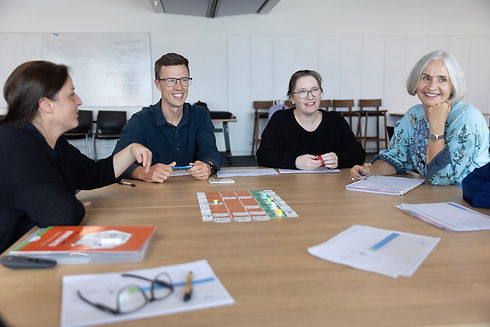
Play and games soften the fear of evaluation
In 2013, I developed the concept of Visual Insights together with Dr Chris Skelly, a systems thinker who remains part of our team today — bringing evaluation and systems thinking together as a genuine collaboration from the very start. My work with communication and design specialists has always been about the same goal: making evaluation something people want to engage with and own, not something done to them. That's what led me to play and games.
There's always a little fear sitting underneath evaluation — fear of being judged, of doing it wrong, of what the results might show. Play takes the edge off that fear and, in doing so, increases motivation to get involved. (I made my first game in Year 10 — and sold the rights to my maths teacher, who turned out to be only a couple of years older than me. He's still around — you might spot him at one of our games sessions in Melbourne.)
Underneath all of it is a belief that evaluative thinking is bigger than evaluation as a single technical practice. It's a way of approaching work and life — a habit of clear and critical thinking that supports lifelong learning, better decisions, and genuinely improved programs. Bringing rigorous evidence-based methods together with the kind of communication and engagement that makes people want to think this way — that's the whole reason Visual Insights exists.
Dr Samantha Abbato
Founder & Director,
Visual Insights People
WHAT'S HAPPENING
July to December 2026

Facilitator game packages
'Thinking Bee'
Thinking Bee Odyssey and Thinking Bee Obstacles are now available as facilitator packages — everything you need to run these games with your own team, without needing us in the room.
Each package includes a facilitator's guide with step-by-step facilitator instructions, presentation videos, a self-paced online course, activity templates and materials to build your team's thinking skills through play. (Game sets available for purchase separately via the online shop)

Online Communities of Practice — Making it Stick
We have recently launched new Communities of Practice for evaluators and program staff who want ongoing peer support, not just a one-off workshop.
The online groups bring together people at similar stages of their evaluation journey to share what's working, troubleshoot challenges, and keep building capability together over time.
Join the Making it Stick (Reporting) Community of Practice below.
Workshops and conference presentations
I'm excited to be facilitating full-day workshops and presenting at two major conferences this year.
AES26 Workshop — Essentials of Qualitative and Quantitative Methods
Darwin, 15 September 2026
EES26 Workshop — A Serious Games Approach to Evaluation Capacity Building
Lille, France, 27 October 2026
I'll also be facilitating online reporting workshops for the AES in October and November 2026.
OUR PEOPLE
Meet the team
A team of experienced evaluation. communication and systems-thinking professionals.

We share a common vision — improving the lives of people experiencing vulnerability by strengthening the community organisations and government agencies that serve them. Our team brings particular strength in working with CALD communities, First Nations peoples, young people, and people with disability, ensuring our approach is genuinely inclusive and responsive to the people and communities we work with.
Our director, Dr Samantha Abbato, is an evaluator with deep expertise across qualitative and quantitative disciplines, and a passion for effective communication and evaluation skill-building using a pictures-and-stories approach grounded in academic rigour.
Alongside Sam, the team includes specialists in systems thinking, leadership, policy and implementation, organisational psychology, graphic communication, illustration and animation, videography, and program evaluation — bringing together the range of disciplines needed to make evaluation genuinely engaging, not just technically sound.
OUR APPROACH
Five ways we are different
1

We build workplace culture
Evaluation takes more than a strategy document and teaching the methods. Strategies imposed on organisations from outside often fail — not because the methodology is wrong, but because no one in the building actually owns it. We help organisations build a workplace culture that sustains outcomes measurement long after we've left the room, through change management grounded in behavioural science and leadership theory.
2

Pictures and stories
We translate the language of evaluation into your organisation's language. Visual tools — cartoons, graphic communication, videography, and best-practice data visualisation — turn abstract concepts into something a team can see, point to, and discuss together, rather than something only the evaluators in the room understand.
We draw on storytelling methods to surface the authentic, context-rich accounts — the evidence that shows people, not just measures them.
3

We use play and games
Games and play-based tools take the fear out of evaluation. Most people approach evaluation guarded — worried about being judged or getting it wrong — and play lowers that guard, building trust and turning a technical exercise into something people look forward to. It also makes learning stick: a shared game gives a team a common language they carry forward long after the session ends, building evaluative thinking as a lasting habit rather than a one-off exercise.
4

A continued learning approach
We believe learning is fundamental to growth, and that shared learning is key to building a strong organisational evaluation culture. We work in partnership to build your capacity continually — remaining close by when you need our technical expertise, and deliberately stepping back as your own capability grows.
The goal of every engagement is to need us less over time, not more.
5

Academic quality applied to real life
Sam and the team bring substantial academic training and experience across several disciplines. We apply that rigour to real-world evaluation, building a genuine bridge from everyday community service delivery to academic-quality outcomes evidence.
We regularly partner with clients to publish and present findings in peer-reviewed journals and at international conferences.
WHAT WE STAND FOR
Our Vision, Mission and Values
OUR VISION:
People and agencies providing services to the community are confidently and competently applying an embedded outcomes evaluation system to share evidence of the difference they make and to reflect on and improve their service delivery.
OUR MISSION:
We partner with the organisations and agencies we work with to increase their social impact using a multi-faceted outcomes evaluation approach that combines rigorous evaluation method with staff skill building — connecting evaluation leads across teams through pictures and stories, coaching and mentoring.
OUR VALUES:
Rigour: Our work is founded on quality, evidence-based data.
Transparency: We believe in being open — about what's working, what isn't, and where we fall short — and we help organisations do the same.
Relationships: We value strong relationships, both within our own team and with the organisations we partner with, and we invest in them at every stage of our work together.
Courage: We're not afraid to try new things. We bring unconventional tools into a field that often plays it safe.
